 Skip to content

If you are researching All-on-X dental implants, you probably have a mix of hope and hesitation. Hope, because you have seen people get a full set of fixed teeth in a single day. Hesitation, because it is surgery, it is a real investment, and you are not sure what actually happens between your first phone call and your final smile.
This guide walks you through the entire All-on-X process from start to finish. We will cover every appointment, what surgery day really feels like, how recovery goes week by week, what it costs, and the questions patients ask us most often. No jargon, no sales pitch, just a clear picture of what to expect.
The short answer: The All-on-X process takes about 4 to 6 months from consultation to final teeth. You receive a fixed set of temporary teeth on the day of surgery, so you are never without teeth. The implants heal and bond with your jawbone over 3 to 6 months, and then your permanent, custom-made teeth are attached.
What Is All-on-X?
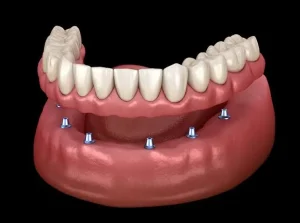
All-on-X is a full arch dental implant treatment. A complete set of fixed replacement teeth is anchored on 4, 5, or 6 dental implants placed in your jaw. The “X” refers to the number of implants, which your dentist chooses based on your bone quality and anatomy. Unlike dentures, the teeth do not come out, do not slip, and do not need adhesive.
You may have heard the term All-on-4. That is simply the version of this treatment that uses four implants. All-on-X is the broader name because some patients do better with five or six implants per arch. Full arch implants have a long track record, with published studies reporting long-term success rates above 95 percent.
Most of our All-on-X patients are in their 40s, 50s, 60s, and beyond. Some have worn dentures for years and are tired of them. Others have spent a decade fighting a losing battle with gum disease, failing root canals, or teeth that break faster than they can be fixed. If that sounds familiar, you are exactly who this treatment was designed for.
Am I a Candidate for All-on-X?
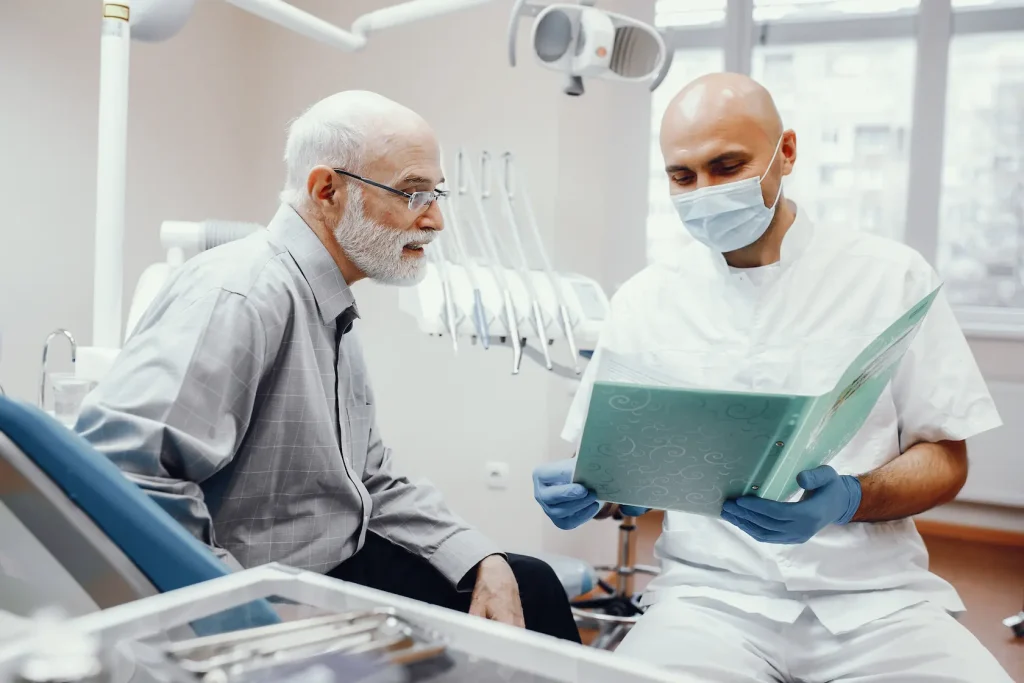
Most adults with failing teeth, extensive tooth loss, or uncomfortable dentures are candidates for All-on-X. Age is rarely a barrier. We regularly treat patients in their 70s and 80s. What matters more is your overall health and the amount of bone available in your jaw.
Here is what your dentist will look at:
- Bone volume. Implants need bone to hold onto. The good news is that All-on-X was specifically designed for people with bone loss. The implants are placed at angles that use the strongest bone you have, so most patients do not need bone grafting. Even severe bone loss does not automatically rule you out; longer implants and other advanced techniques can help in those cases.
- General health. Well-controlled diabetes, high blood pressure, or heart conditions usually do not prevent treatment. Your medical history is reviewed carefully, and your dentist may coordinate with your physician.
- Smoking. Smoking raises the risk of implant failure because it slows healing. You do not have to quit forever, but you will be asked to stop or cut back around the time of surgery and during healing.
- Gum disease. Active infection is treated as part of the process, often by removing the failing teeth at the time of implant surgery.
The only way to know for sure is a proper evaluation with a 3D scan. Many practices, including ours, offer this initial consultation at no charge.
The All-on-X Process Step by Step
Here is the full timeline, from your first visit to your final teeth.
Step 1: The Consultation and 3D Scan (1 to 2 Visits)
Your first appointment is about information, not commitment. You will receive:
- A 3D CBCT scan of your jaws, which shows bone volume, nerve positions, and sinus anatomy in detail a regular X-ray cannot match
- An honest assessment of whether All-on-X is right for you, or whether a different option would serve you better
- A complete, all-inclusive cost estimate and a review of financing options
This is also your time to ask questions. Write them down beforehand. Good questions include: How many implants will I need? Who performs the surgery? What is included in the quoted price? What happens if an implant fails? A trustworthy practice will welcome every one of these.
Step 2: Treatment Planning (Behind the Scenes)
Using your scan, your dental team digitally plans the exact position, angle, and depth of every implant before surgery ever begins. Your new teeth are also designed in advance, considering your facial structure, your bite, and how you want your smile to look. Many patients bring in old photos of their natural smile. This planning stage is one of the biggest reasons modern implant surgery is so predictable.
Step 3: Surgery Day (One Appointment)
This is the day most patients are nervous about, so let us walk through it honestly.
Anesthesia and comfort. You will not feel the surgery. Most patients choose IV sedation, which means you are deeply relaxed and remember little or nothing of the procedure. Local anesthesia keeps the entire area numb. If you have dental anxiety, say so; sedation dentistry exists precisely for you.
What happens. In a single appointment, your dentist removes any remaining failing teeth, smooths and shapes the bone, places the implants (typically 4 to 6 per arch), and attaches a fixed set of temporary teeth. The whole visit usually takes 2 to 4 hours per arch.
You leave with teeth. This is the part that surprises people. You walk out the same day with a full, fixed, natural-looking set of temporary teeth. You will never sit at home with no teeth, and nobody at the grocery store will know you had surgery that morning.
You will need someone to drive you home, and we recommend taking it easy for the rest of the day.
Step 4: The First Two Weeks of Recovery
Most patients say recovery was easier than they feared. Here is a realistic picture:
- Days 1 to 3: Swelling and some bruising peak around the second or third day. Discomfort is real but manageable; most patients do well with over-the-counter pain relievers like ibuprofen after the first day or two. Ice packs, rest, and keeping your head elevated help a lot.
- Days 4 to 7: Swelling starts going down. Many patients return to desk work within 3 to 5 days. If your job is physically demanding, plan for a week or a bit more.
- Week 2: Most visible signs of surgery are gone. You will come in for a follow-up visit so we can check your healing.
You will be on a soft food diet during this time: eggs, yogurt, soups, smoothies, mashed potatoes, pasta, soft fish. It is temporary, and it matters, because the implants underneath are just beginning to bond with your bone.
Step 5: Healing and Osseointegration (Months 1 to 4)
Over the next several months, your jawbone grows onto and fuses with the titanium implant surfaces. This process is called osseointegration, and it is what makes implant teeth feel solid and permanent.
During this phase you will wear your fixed temporary teeth and gradually advance your diet from soft foods to firmer foods, following your dentist’s guidance. You will have periodic check-ups to confirm everything is integrating as planned. Most patients are back to completely normal life; the healing is happening quietly beneath the surface.
A note on speech: some patients notice a slight lisp or a feeling of “full” speech for the first few weeks with the new teeth. Your tongue adapts quickly. Reading aloud at home speeds this up, and for nearly everyone it resolves on its own.
Step 6: Your Final Teeth (Months 4 to 6)
Once your implants are fully integrated, your permanent teeth are made. The final prosthesis is typically milled from zirconia, an extremely strong ceramic that looks like natural teeth and resists staining and wear. You will have try-in appointments to fine-tune the fit, the bite, and the appearance. When you and your dentist are both happy, the final bridge is secured to your implants.
At this point you can eat essentially anything: steak, apples, corn on the cob, crusty bread. Your bite strength returns to near-natural levels, something dentures can never offer.
How Much Does All-on-X Cost?
In the United States, All-on-X treatment typically costs between $20,000 and $35,000 per arch with a high-quality acrylic hybrid bridge, and $30,000 to $50,000 per arch with a premium zirconia bridge. The price generally includes the scan, extractions, implants, temporary teeth, and the final prosthesis, but always confirm exactly what a quote covers.
That is a significant number, and it deserves honest context. This is a one-time reconstruction meant to last decades, performed by a surgical and restorative team, using custom-fabricated teeth. When patients compare it to the running cost of repeated crowns, root canals, extractions, partials, and denture relines over 10 to 20 years, the math often looks different than expected.
Be cautious with prices that look too good to be true. Extremely low quotes often exclude extractions, sedation, or the final teeth, or rely on discount components. Ask any provider for an all-inclusive, written estimate.
For a full breakdown of pricing factors, see our guide on the cost of full mouth dental implants.
Does Insurance Cover All-on-X?
Dental insurance rarely covers the full treatment, but it often covers parts of it, such as extractions, imaging, or a portion of the prosthesis, up to your annual maximum. Our team checks your benefits and files claims on your behalf so you get every dollar you are entitled to.
Financing Options
Most patients finance some or all of their treatment. Common options include:
- Healthcare financing companies such as CareCredit and Proceed Finance, which offer fixed monthly payments and, in some cases, promotional interest-free periods
- In-house payment plans, which many practices offer directly
- FSA or HSA funds, which can be used for implant treatment with pre-tax dollars
Typical financed payments often land in the range of $500 to $1,000 per month depending on the amount financed, the term, and your credit. If cost is the main thing holding you back, ask about financing at your consultation before ruling anything out.
Common Fears, Answered Honestly
After thousands of conversations with patients, the same worries come up again and again. You are not alone in any of these.
“I’m terrified of the surgery.” Fear of dental work is the single most common reason people wait years longer than they should. With IV sedation, most patients remember almost nothing and report that the anticipation was far worse than the reality. Tell your dentist about your anxiety at the consultation. It changes how we plan your care.
“I’m embarrassed by the state of my teeth.” Dentists who focus on full arch treatment have seen everything, truly everything, and the patients they remember are not the ones with the worst teeth but the ones who were happiest afterward. You will not be judged. You will be helped.
“What if the implants fail?” No honest provider promises 100 percent, but full arch implants succeed more than 95 percent of the time in published long-term studies. In the uncommon event an implant does not integrate, it can usually be replaced. Choosing an experienced surgical team and following aftercare instructions are the two biggest factors within anyone’s control. Also ask what warranty the practice offers on implants and teeth.
“Am I too old for this?” No. Health matters far more than age, and implant treatment is routinely successful for patients in their 70s and 80s. Many older patients say their only regret is not doing it sooner, while they were missing out on foods, photos, and social life.
“Will they look fake?” Modern zirconia teeth are custom-designed for your face, your lip line, and your preferences. You approve the appearance before anything is final. Most people around you will simply notice that you look healthier and happier, not that you had dental work.
Life After All-on-X: Caring for Your New Teeth
Your new teeth are low-maintenance, but not no-maintenance. Daily care means brushing twice a day and cleaning under the bridge with tools like a water flosser or special brushes. You will also come in for professional cleanings and check-ups, typically two to three times a year, where the bridge and implants are examined and professionally cleaned.
With that routine, the implants themselves can last a lifetime. The teeth attached to them are subject to normal wear, like natural teeth, and may need maintenance or replacement after many years, especially acrylic versions. Zirconia bridges are significantly more durable.
How to Choose the Right Provider
The skill and experience of your surgical team matter more than any other single factor. As you compare providers, ask:
- How many full arch cases has the team completed?
- Is the surgery and the restorative work done under one roof, by doctors who work together daily?
- Is the price all-inclusive and in writing?
- What technology is used for planning (3D CBCT imaging, digital smile design)?
- What happens, and what does it cost, if something needs adjustment later?
- Can you see real patient results and speak to reviews from people like you?
A good practice will answer all of this without hesitation and will never pressure you to decide on the spot.
Frequently Asked Questions
How long does the All-on-X process take from start to finish?
Most patients complete the full All-on-X process in 4 to 6 months. Implant placement and fixed temporary teeth happen in a single surgical appointment. The remaining months are for healing and osseointegration, followed by the fitting of your permanent zirconia or acrylic bridge.
Is the All-on-X procedure painful?
You will not feel pain during surgery thanks to local anesthesia and sedation. Afterward, most patients describe soreness and swelling for 3 to 7 days, usually managed with over-the-counter pain relievers. The majority of patients say recovery was easier than they expected.
Do I go without teeth at any point?
No. With All-on-X you receive a fixed set of temporary teeth on the same day your implants are placed. You leave the surgical appointment with a complete, non-removable smile and wear it throughout the healing period.
How much do All-on-X dental implants cost in the US?
All-on-X typically costs $20,000 to $35,000 per arch with an acrylic hybrid bridge and $30,000 to $50,000 per arch with a zirconia bridge in the United States. Financing through options like CareCredit or Proceed Finance can bring payments to roughly $500 to $1,000 per month.
How long do All-on-X implants last?
The titanium implants can last a lifetime with good hygiene and regular dental visits. The attached bridge experiences normal wear: acrylic bridges often need replacement after 5 to 10 years, while zirconia bridges commonly last 15 years or more.
Can I get All-on-X if I have bone loss?
Usually, yes. All-on-X was designed for patients with bone loss. Implants are angled to use the densest available bone, so most patients avoid grafting entirely. Even with severe bone loss, advanced options such as longer or zygomatic implants may make treatment possible.
What can I eat after All-on-X surgery?
You will follow a soft food diet for the first several weeks: smoothies, eggs, yogurt, soups, pasta, and similar foods. Your dentist will guide you back to firmer foods as healing progresses. Once your final teeth are placed, you can eat virtually anything, including steak and raw vegetables.
Will my insurance pay for All-on-X?
Full coverage is rare, but many dental plans cover portions of treatment such as extractions, imaging, or part of the prosthesis, up to your annual maximum. Ask your provider to verify your benefits; FSA and HSA funds can also be applied.
Ready to See if All-on-X Is Right for You?
Reading about the process is one thing. Knowing what is possible for your mouth is another, and that answer only comes from an exam and a 3D scan.
Advanced Smile Dentistry offers a Complimentary consultation with a 3D scan at our Toms River, NJ offices. You will leave with straight answers, a clear treatment plan, and an all-inclusive written estimate, with zero pressure to commit. Call (732) 608-6478 or request your visit online, and take the first step toward eating, smiling, and living without thinking about your teeth.